INDEPENDENT FUTEK CONFIGURATION REVIEW
FUTEK donut load cell alternatives for your installed fixture.
Keep the complete LTH / FSH item and mating cable visible. The center bore, loading contact, connector and bridge signal must work together before an alternative can be approved.
Send the FSH item & fixture requirements ↓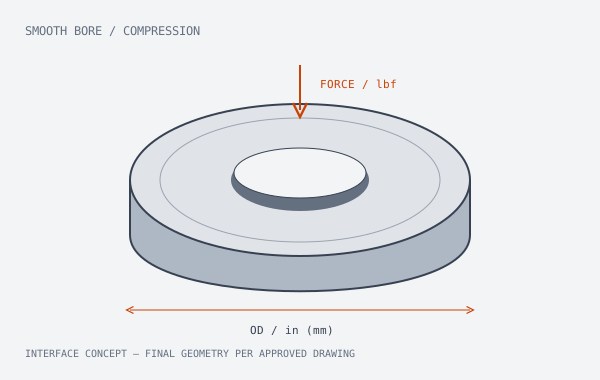
ORIGINAL-MODEL REFERENCE MATRIX
FUTEK model inputs for an engineering comparison
These are original manufacturer reference properties. The DLC column identifies where to start a drawing review; it does not identify an approved interchangeable SKU.
| Original brand / model | Original reference inputs | DLC review direction | Checks before approval |
|---|---|---|---|
| FUTEK LTH350 Original documentation ↗ | Original drawing FI1542-B specifies 700 ohm, 4-position micro receptacle and 1.5 mV/V at 100 lb versus 2 mV/V for listed higher ranges. | DLC-100 / DLC-LP within the applicable range | Check the exact FSH item, nominal versus actual ID, connector orientation, mating cable, range-dependent sensitivity and loading surfaces. |
Provide the original part number, drawing, calibration and receiving-instrument model. Prices, stock and delivery are quoted for the actual configuration.
Review the evidence package before procurement →Keep the exact item and drawing revision.
LTH is a family name. For an LTH300, LTH350, LTH400 or LTH500 inquiry, include the FSH item number and the drawing for that unit. A nominal shaft fraction, similar photograph or shared material name cannot establish the finished ID or interchange fit.
Measure the actual center opening, outside diameter, height, loading and support surfaces. Include washer thickness, cable bend space and the mating connector rather than comparing the bare sensor alone.
Connector fit includes the cable.
A four-pin count alone does not identify the mating thread, keying, contact arrangement or polarity. Supply the connector part number, pin-numbering view and cable assembly. Check whether the installed version has an integrated receptacle or a fixed lead before ordering.
An alternative connector or adapter also changes the installed envelope and serviceability; include it in the drawing review.
700 ohm and mV/V are separate electrical decisions.
At the same excitation, bridge power follows V²/R: changing from 350 to 700 ohm approximately halves the bridge dissipation. It does not by itself halve the readout power or establish the same sensitivity, noise or thermal performance.
The linked LTH350 document distinguishes a 1.5 mV/V 100 lb version from 2 mV/V listed higher ranges. At 10 V excitation, those nominal full-scale signals are 15 mV and 20 mV respectively. A display scaled for one cannot be assumed to read the other correctly without a new comparison and zero/span procedure.
For a DLC assessment, provide excitation, bridge resistance, required signal resolution and the existing instrument. Connector and bridge choices need configuration-specific confirmation.
Verify the force path before keeping the existing washers.
Identify the active loading surface, fixed support and any non-loading area on the original drawing. A washer or base that bridges these regions can restrain the intended elastic response. Match contact diameters and support rather than treating every annular face as a loading face.
Use DLC-LP as a narrow-gap review direction only within its published force scope. A higher-force LTH installation may need DLC-100 or a custom configuration; no LTH-wide replacement rating is implied.
Review the mounting stack and electrical checklist →